
Fresh Cayenne vs. Chili Powder: Solving the Heat Distribution Problem in Scrambled Eggs
Eliminate spicy landmines in your breakfast by understanding the physics of capsaicin dispersion and choosing the right form of heat for a consistent scramble.

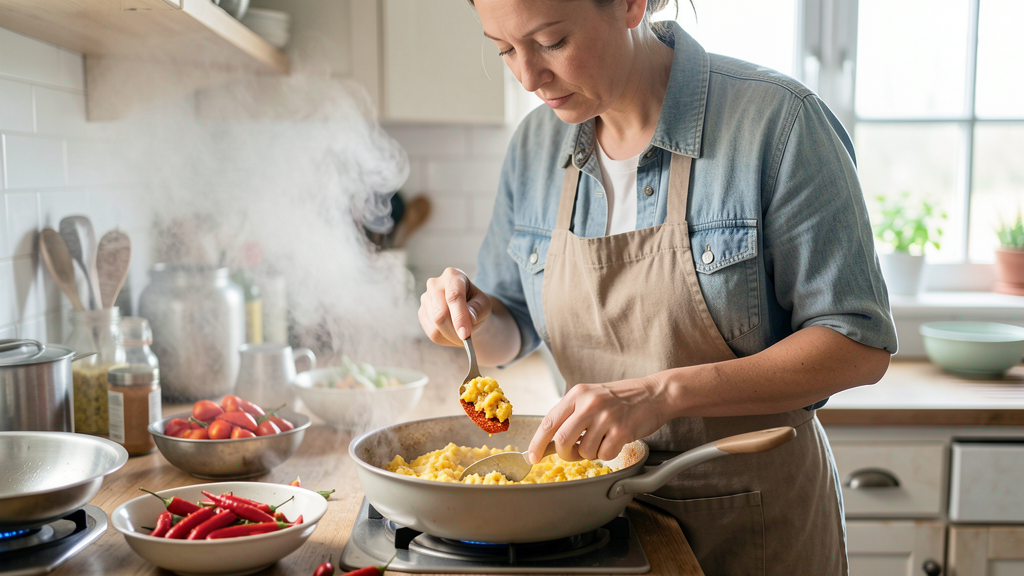
There is nothing more frustrating in the kitchen than the "hot spot" lottery. You sit down for a simple breakfast, take a forkful of soft, buttery scrambled eggs, and it is mild, creamy, and pleasant. Two bites later, your palate is assaulted by a singular, searing spike of capsaicin that burns out the subtle flavors of the dairy and eggs. You ate the same dish, but you experienced two different meals. This inconsistency is the primary reason I stopped recommending fresh whole peppers for quick egg scrambles years ago.
When we look at the mechanics of how heat interacts with the protein matrix of eggs, the physical state of your spice matters more than the variety. Fresh cayenne brings a vegetal snap and immediate bite, but it fails at homogeneity. Chili powder, or specifically the dust of ground dried peppers, offers a mathematical advantage in coverage that ensures every curd carries the same weight of spice. If you are tired of playing Russian roulette with your morning heat, it is time to analyze how these two forms disperse in the pan.
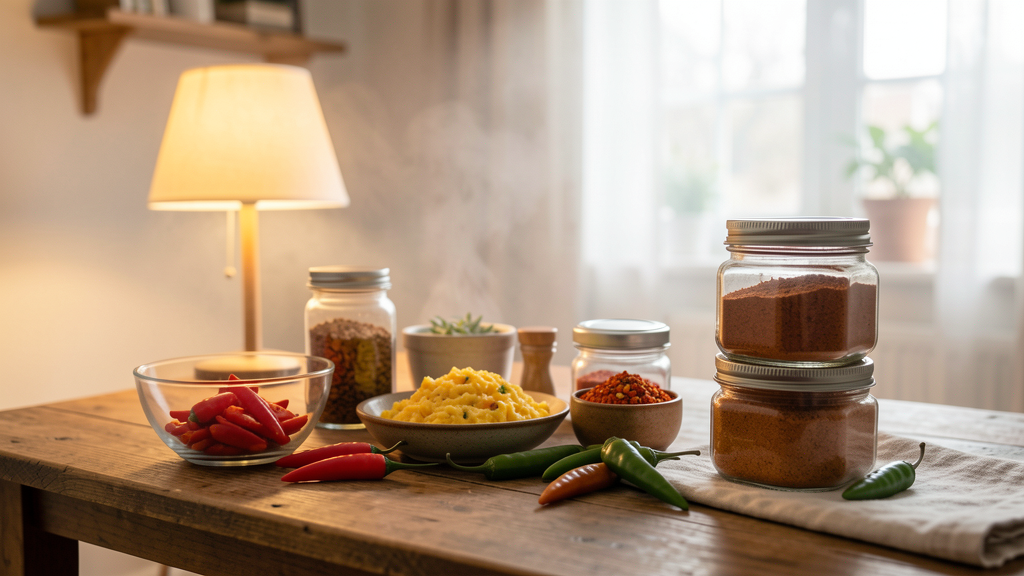
The Geometry of Fresh Capsicum
The allure of a fresh cayenne pepper is undeniable. Slender, bright red, and tapering to a sharp point, it looks like a culinary dart of pure fire. However, using it fresh introduces a physical limitation: volume. A standard cayenne pepper measures between five to six inches in length, but its internal volume is hollow. When you slice it into thin rounds, you are creating distinct, isolated packets of heat.
In the context of a weeknight-heat favorite like eggs, these packets do not dissolve. As you fold the eggs, the pepper slices tumble and settle. You might distribute twenty slices into three eggs, but statistically, some forkfuls will contain zero slices, while others might clump together, delivering two or three times the intended scoville scale in a single second.
Furthermore, we have to consider the origin and variety of the pepper itself. The cayenne we know is named after the city of Cayenne in French Guiana, a cultivar of Capsicum annuum prized for its thin skin and high heat-to-flesh ratio. While the fresh form offers a bright, grassy acidity that powders often lose during the drying process, that moisture is a double-edged sword. The water content inside a fresh pepper creates a steam barrier when it hits the hot fat. Instead of releasing capsaicin into the oil to be absorbed by the eggs, the pepper steams from the inside out, keeping much of its volatile oils trapped within the cell walls of the vegetable slice.
If you cannot find true fresh Cayenne at your local market, do not substitute with a thick-walled pepper like a Jalapeño; the flesh is too wet and the heat too low for the desired effect. Instead, look for a Red Thai Bird's Eye Chili or a Fresno Pepper. Both possess the thin skin and water content necessary to mimic the textural impact of a Cayenne, though the Bird's Eye will ramp up the ferocity significantly.
Why Dusting Outperforms Slicing
The argument for powder comes down to surface area and particulate distribution. When you use chili powder—whether it is a pure ground cayenne or a complex blend containing cumin and garlic—you are dealing with a particulate matter that behaves like a seasoning, not a vegetable ingredient.
Salt and pepper work in scrambled eggs because the granules are small enough to adhere to the microscopic texture of the egg proteins. Powdered chili does the same. Each grain of ground chili carries the essential oils of the fruit. Because these grains are microscopic, they disperse evenly throughout the matrix of the eggs. You are not relying on chance to hit a slice; you are inhaling and tasting a background hum of heat that is consistent in every millimeter of the dish.
This dispersion creates a different kind of sensory experience. Instead of the sharp "ping" of a fresh slice hitting the tongue, you get a rising, pervasive warmth. The heat builds gradually and evenly. I have found that when cooking for an audience that might be wary of spice, this method is far superior. It mimics the technique I discussed when I wrote about how I got my family to eat spicy tacos by using smoked paprika; the integration of the spice into the sauce—or in this case, the egg—makes it palatable and approachable rather than aggressive and shocking.
There is also a chemical benefit regarding the breaking of the eggs. Adding fresh vegetables introduces extraneous moisture. Weeping water in scrambled eggs creates a curd that is rubbery or, worse, separates into a greasy, soupy mess. Dry spices, conversely, can help stabilize the emulsion if managed correctly. They absorb a fraction of the moisture released from the eggs during the cooking process, contributing to a denser, creamier curd.
The Texture Trade-Off
I would be remiss if I did not acknowledge the loss of texture when choosing powder over fresh. A fresh slice of cayenne offers a pleasing crunch, a "pop" that breaks the monotony of the soft eggs. Powder offers no resistance; it disappears completely into the dish.
For some, this is a dealbreaker. We eat with our eyes and our mouths, and the absence of identifiable red flecks can make a dish feel less "homemade." This is where technique bridges the gap. You do not have to abandon the flavor of fresh peppers to solve the distribution problem. You simply have to change the delivery mechanism.
One of the most effective methods I have adopted in my kitchen this year is "blooming" the powder in the fat before introducing the eggs. However, if you crave that fresh bite, consider using the powder for the base heat and finishing the dish with a single, chiffonade of fresh pepper placed entirely on top. This serves as a garnish rather than a mix-in. The diner sees the fresh heat and can choose to incorporate it, but the underlying eggs remain perfectly consistent.
Alternatively, you can extract the flavor and heat of the fresh pepper without the unevenness by infusing your fat first. If you take the time to infuse olive oil with chili flakes in under 15 minutes using the fresh pepper slices, you remove the physical solids. The oil becomes a uniform carrier of the heat. When you scramble your eggs in this oil, the heat distribution is mathematically perfect, yet you retain the fresh, volatile top notes of the raw cayenne that the dried powder lacks.
The Verdict on Weeknight Efficiency
When the clock is ticking and you need a reliable result, the winner is clear. While I love the aesthetic and sharp bite of a fresh cayenne slice, the inconsistency of its heat distribution disqualifies it as the primary heat source for a scramble. The risk of a "hot spot" is simply too high, and the moisture content threatens the texture of the eggs.
Chili powder, specifically a high-quality pure cayenne powder or a finely ground blend, provides the control and consistency that a morning meal requires. It coats the protein, disperses the capsaicin evenly, and allows you to precisely dial in the heat level. You can always add a fresh slice on top for the crunch, but for the internal chemistry of the dish, the dust wins every time.
The Ultimate Fix for Heat Seekers
We have established that powder mixes better and fresh pepper tastes brighter. The conclusion, therefore, is not to pick one permanently, but to use them sequentially. The best strategy I have found for 2026 is a "double-hit" method that solves the moisture problem while retaining the fresh profile.
Start your eggs as you normally would, but whisk your chili powder directly into the raw egg mixture with a pinch of salt. Let this sit for five minutes while the pan heats. This hydrates the powder, allowing the heat to permeate the liquid egg before it even touches the pan. Cook your eggs slowly in butter. Once they are plated and off the heat, drizzle a few drops of a raw, fresh cayenne oil over the top. You get the consistent, building warmth from the powder integrated into the curd, and the immediate, bright, floral hit of the fresh pepper on the tongue without the "hot spot" gamble. It requires an extra step, but the result is a scramble where the heat is not a surprise, but a promise kept in every bite.
Read next
The 12-Minute Chili Oil Trick That Saved My Tuesday Dinner
A gentle-heat method to extract complex chili flavors in minutes, transforming a bland weeknight roast into a restaurant-grade dish without the wait of cold infusion.
By Lucas Oliveira · 8 min read
The Smokiness Trojan Horse: How Smoked Paprika Saved Taco Tuesday
Learn how a strategic switch from hot sauce to oak-smoked paprika bypassed my family's heat defenses and retrained their palates for real spice.
By Lucas Oliveira · 6 min read